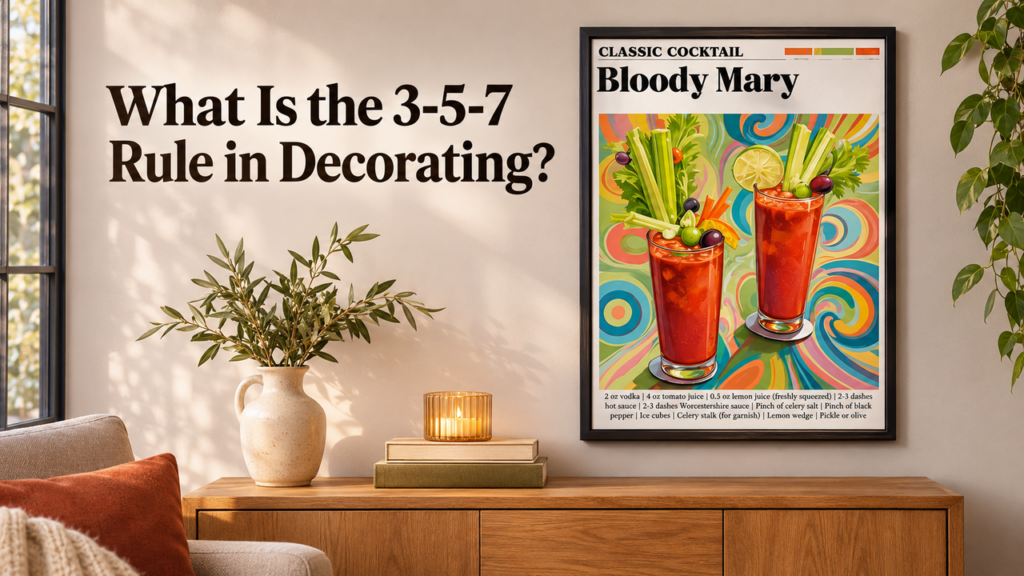
The 3-5-7 rule in decorating is a flexible way to arrange objects in groups of three, five, or seven. The idea is to use an odd number as a starting point for a display that feels balanced without needing perfect symmetry.
You don’t have to use all three numbers in one room, and you don’t have to keep counting if another arrangement looks better. Apartment Therapy’s account of the 3-5-7 rule describes it as an approach to styling odd-numbered groups, including larger arrangements when three objects aren’t enough for a surface.
Choose a count that fits the space
Start with the area you want to decorate, rather than gathering seven things and trying to make them fit.
- Three is a useful starting point for a small shelf, a counter corner, or a compact wall grouping. It leaves room to experiment without filling every inch.
- Five can work on a longer shelf or a surface where three small items look scattered. Try arranging them as a loose group rather than spreading them evenly from end to end.
- Seven gives you more to work with on a generous surface, such as a wide mantel or long sideboard. It also needs more editing: if the objects blend into a jumble, remove one or more and reassess.
These are suggestions, not requirements. A wide surface might look best with one large piece, and a small shelf could hold five little objects comfortably. The test is whether the arrangement suits the space and leaves room for its practical use.
If you’re unsure where to begin, clear the area and put back three pieces you like. Live with that arrangement for a while before adding more. It’s easier to see what’s missing when you aren’t starting with a crowded surface.
Make the group feel balanced
An odd count alone won’t make a display look finished. Once you’ve chosen your objects, adjust how they relate to one another.
Vary the height and shape. A tall vase, a lower bowl, and a small framed piece offer different outlines. You don’t need dramatic differences; enough variation to distinguish the pieces can be sufficient.
Choose an anchor. Start with the object you want to notice first, then arrange the others around it. The anchor doesn’t have to sit in the middle. A taller item toward one side can be balanced by two smaller items nearby.
Leave breathing room. Objects can overlap slightly when viewed from the front, but they don’t all need to touch. Step back and check whether you can see each piece clearly. If the display feels crowded, try removing an item before rearranging everything.
Count visual units consistently. For planning purposes, you might treat a stack of books as one unit and a vase beside it as another. That’s a styling choice, not a strict counting rule. If the stack reads as several separate pieces to you, count it differently—or stop counting and judge the overall effect.
Balance also doesn’t mean every side must have the same number of objects. If one side feels too heavy, try moving a smaller object closer to the other side or leaving more space around the larger piece. View the arrangement from where you normally see it, not only from directly in front.
Try it on a kitchen shelf or bar cart
On a kitchen shelf, start with three things you already own: a small framed piece, a bowl, and a vase, for example. Put the tallest item slightly off-center, then move the other two until the group feels connected. If the shelf is long and the display looks lost, add two objects that differ in shape or height.
Practicality matters as much as appearance. If you use the bowl regularly, keep it easy to reach rather than trapping it behind the display. Leave enough space to lift things off the shelf without disturbing everything around them.
For a bar cart, consider three visual units: a tray, a bottle, and a small decorative object. A tray can help contain loose essentials, but the cart still needs usable space for the things you reach for. Keep frequently handled items accessible, and avoid placing unstable decorations where they could be knocked over. If the cart is already busy, one decorative accent may be enough.
Kitchen counters call for the same restraint. Clear the area you need for food preparation first, then see what space remains for a small arrangement. Keep decor away from heat, moisture, and other conditions that could damage it or interfere with cooking.
Use the idea for a wall-art grouping
The rule can also guide a gallery wall: try three pieces as a single group, then decide whether the wall needs more. The pieces don’t have to match exactly. A shared subject or a consistent framing approach can help them feel connected, while differences between the artwork keep the grouping interesting.
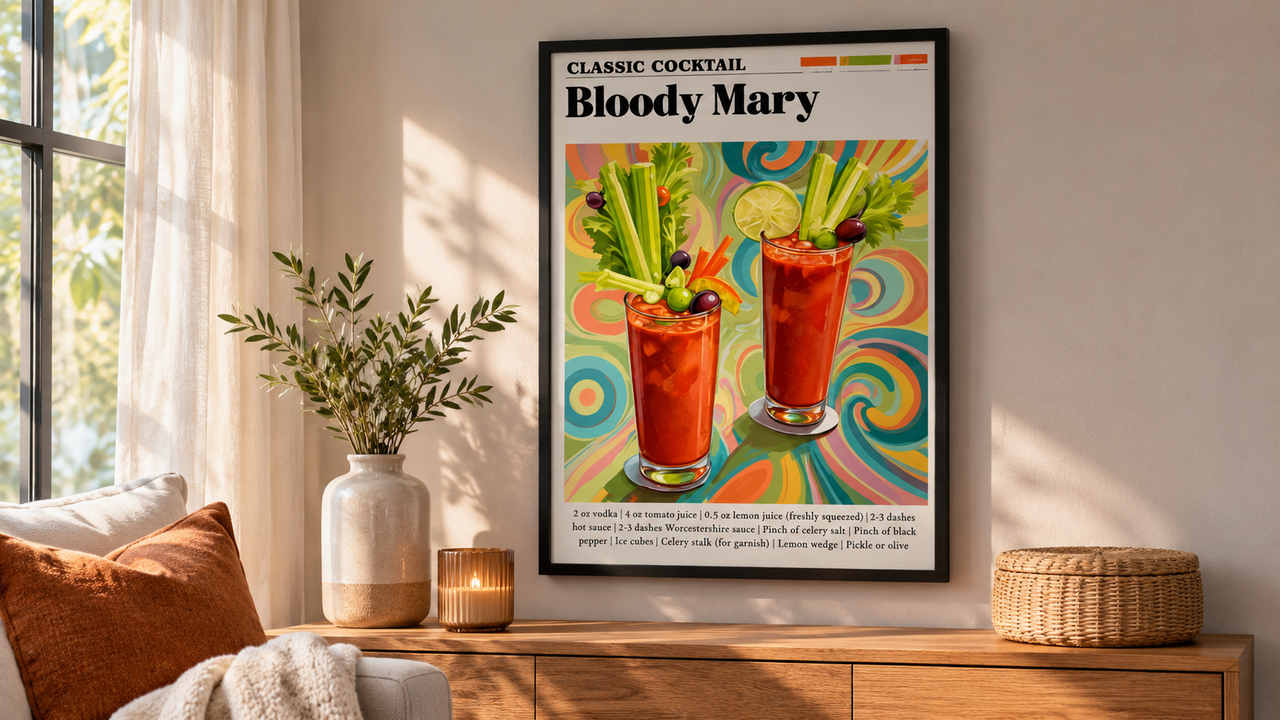
For a cocktail-themed corner, you could combine a Bloody Mary print and a dirty martini print with a third piece you already own. Each linked listing is an individual wall-art product, not an included matching set. Alternatively, use just one print as a focal point above a cart and let the cart’s contents form their own arrangement below.


Before hanging multiple pieces, cut paper templates to the dimensions of the art you plan to use and position them on the wall. Try a row if the available space is wide, or a looser cluster if the pieces vary in shape. Adjust the gaps until the pieces read as a group rather than separate decorations scattered across the wall.
Step back to see the templates in relation to the furniture and surrounding space. Check that doors and cabinets can open freely, too. Once you like the layout, follow the appropriate hanging instructions and choose hardware suited to your wall and artwork.
A three-piece display isn’t automatically better than a single piece, especially on a small wall. For more help deciding what fits, see how to choose wall art for a small room without overcrowding it.
When to break the rule
Use a pair when you like the simplicity of two pieces together. Choose one substantial piece when several smaller ones would make a narrow space feel busy. And if a shelf looks best with four objects you love, there’s no need to add a fifth just to satisfy a formula.
The most useful part of 3-5-7 is the prompt to try a deliberate grouping. Start with a count, look at the arrangement from where you normally see it, and change the number or spacing until it works for your room.