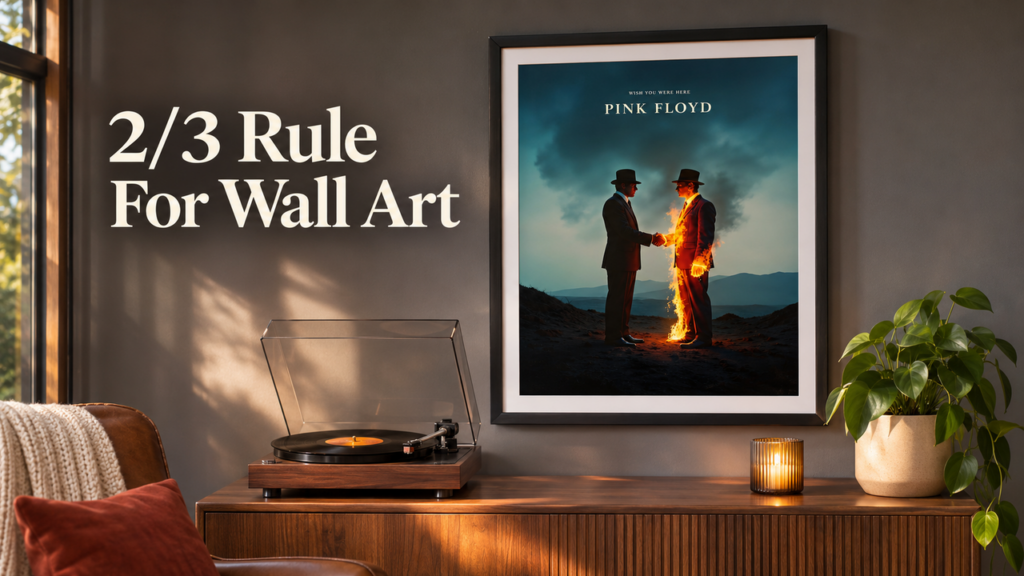
The 2/3 rule for wall art is a starting point for choosing art above furniture: aim for one piece or a complete grouping that is about two-thirds as wide as the furniture beneath it. Above a 90-inch sofa, for example, that works out to roughly 60 inches. It’s a proportion guide, not a requirement; your room, the art, and the effect you want matter too.
Calculate your target width
Measure the full width of the furniture you want the art to relate to, then multiply that number by two and divide by three. You can also multiply by approximately 0.67.
For example:
- A 90-inch sofa gives you a target of about 60 inches.
- A 72-inch console gives you a target of about 48 inches.
- A 60-inch headboard gives you a target of about 40 inches.
The target applies to the *finished display*, not necessarily just the printed image. If you plan to frame a print, measure the frame’s outside edges. For a group, include the spaces between pieces. This is the approach described in ARTmine’s guide to the 2/3 rule.
If you center a 60-inch-wide display above a 90-inch sofa, it will leave approximately 15 inches of sofa width beyond the art on each side. That can help you visualize the proportion, though you don’t have to measure those margins perfectly when deciding what looks right.
Before buying, keep your target handy while reviewing listing dimensions. If you plan to add a frame separately, allow for its outside width too. A print’s dimensions alone may not tell you how much wall space the finished piece will occupy.
Measure one piece or a group
For a single piece, compare its finished width with your target. It doesn’t have to land on the number exactly. A narrower piece may still look right if you want a quieter display or prefer to leave more open wall around it.
For several pieces in a row, add their outside widths and the gaps between them. A hypothetical row of three framed pieces, each 18 inches wide, with two 3-inch gaps would span 60 inches:
18 + 3 + 18 + 3 + 18 = 60 inches
That row meets the starting target above a 90-inch sofa. These numbers illustrate the calculation; they are not dimensions of a particular product.
An arrangement doesn’t have to be a straight row. With a staggered or stacked gallery wall, measure from the leftmost outside edge to the rightmost outside edge of the whole composition. Two arrangements with the same width can feel different: a tightly packed group reads more like a single unit, while wider gaps give each piece more separation.
If you own a piece that seems too narrow on its own, you can enjoy it as a smaller focal point or build an arrangement around it with pieces you choose separately. Don’t add art just to hit a number if the grouping feels crowded or the pieces don’t belong together to you.
Test the layout before making holes
A mockup helps you compare proportions before committing to a position. Cut paper to the finished outside dimensions of each piece, or mark the intended outlines with removable tape after checking that it’s suitable for your wall. If you haven’t chosen an exact piece yet, mock up your calculated target width to see how much space it would occupy.
Step back and look from the room’s main viewing spots, including where you normally sit or enter. Consider:
- Whether the display feels connected to the furniture rather than stranded above it.
- Whether you want the group centered over the furniture, even if the furniture is not centered on the wall.
- How much space remains around nearby doors, shelves, lamps, or other objects.
- Whether the gaps within a group look deliberate, even when the pieces are different shapes.
Try the arrangement slightly wider, narrower, higher, or lower. A phone photo can help you compare versions without relying on memory. If a large mockup crowds a lamp or overlaps a doorway, a smaller arrangement may be more useful than a mathematically exact one.
The width rule doesn’t set the hanging height
Two-thirds tells you how wide a display might be; it doesn’t tell you how high to hang it. Above a sofa, bed, or console, use the furniture as a visual reference. Leave enough clearance that the art doesn’t interfere with the furniture or the people using it, but avoid placing it so high that it appears disconnected. Consider sightlines from both seated and standing positions.
On an open wall without furniture underneath, there’s no furniture width to put into the formula. Instead, judge the display against the available wall area and nearby features. The ARTmine guide mentions 57–60 inches from the floor to the center of an artwork as a typical starting point. Treat that as another guideline, not a substitute for checking the room. For a group, consider the center of the overall arrangement rather than the center of every individual piece.
For installation, follow the instructions for your chosen hanging hardware and check that the attachment method suits the wall and the weight of the finished piece. A paper mockup helps with placement; it doesn’t determine what will safely support the art.
When to go smaller or larger
Choose a smaller display deliberately if you want generous empty space, have a favorite piece you don’t want to surround with others, or need to work around a nearby feature. A smaller piece can feel intentional; try adjusting its position before deciding it looks out of place.
Consider a wider display if you want a more dominant focal point or have a broad wall and substantial furniture. Check the full arrangement in a mockup so it doesn’t visually collide with surrounding objects. The tradeoff is how much emphasis and breathing room you want—not whether you have followed a rule perfectly.
Apply the rule to music wall art
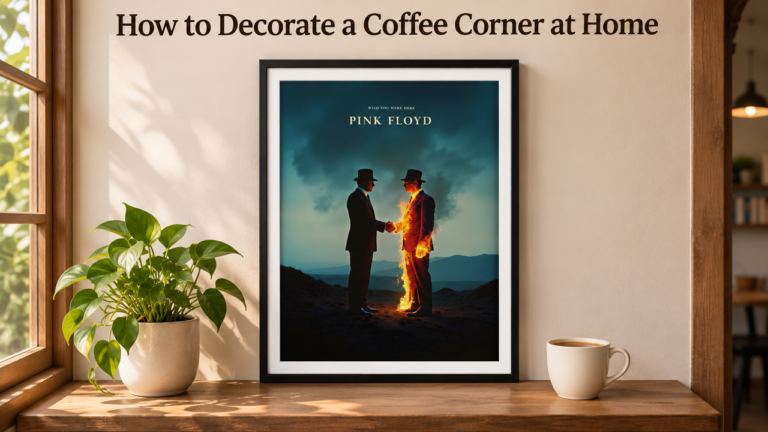
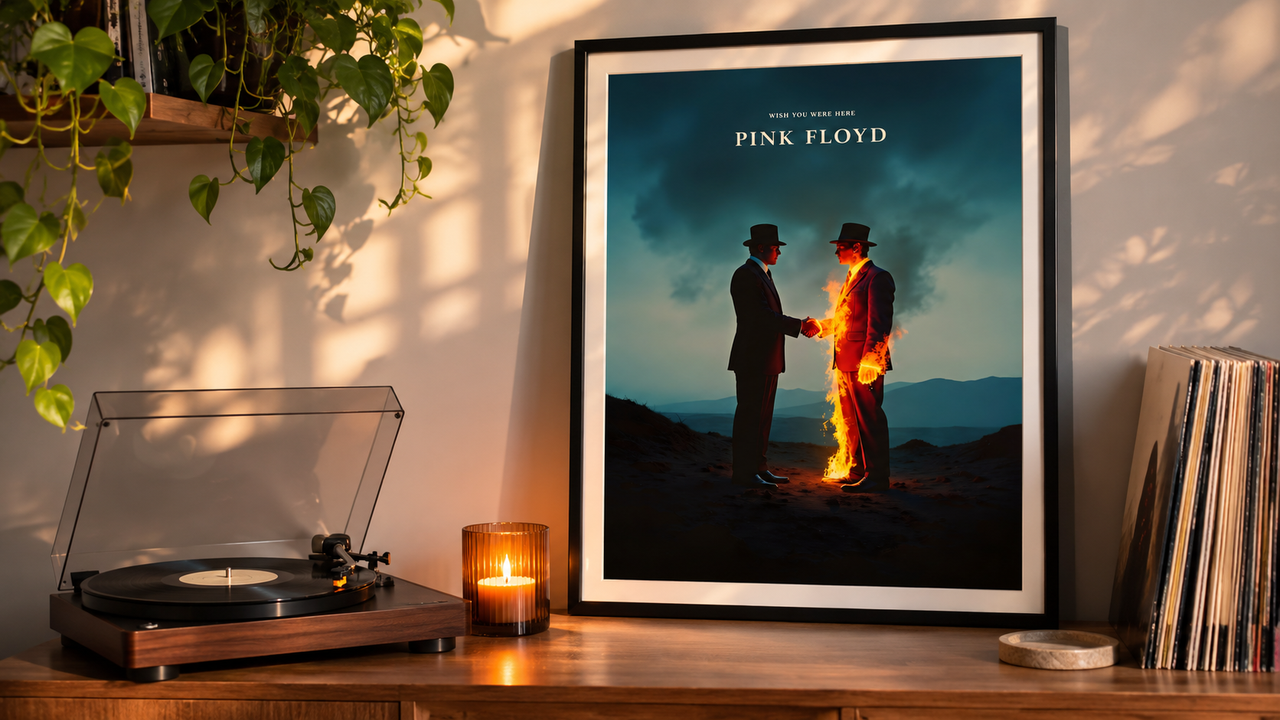
Start with the artist or music that matters to you, then compare the available dimensions with your target. For example, a Pink Floyd Wish You Were Here poster could be considered as a single focal piece. Review the listing’s available options and dimensions before deciding whether it works alone in your space.

If a music print is smaller than your target, it can still be the centerpiece of a display. You could arrange it with other art you select separately, measuring the combined outside width and gaps rather than the print alone. Or leave it on its own and let the surrounding wall stay open.
Buying for someone else? Proportions are easier to judge if you know where they might display the art, but their connection to the music matters too. For help choosing a subject when you don’t know their exact wall dimensions, see how to choose music wall art as a personal gift.